

Writing content that ranks on Google isn’t as easy as it seems. Repeating keywords, stuffing articles with headlines, or writing for search engines instead of people are all outdated practices.
Google’s search systems have become more sophisticated at understanding content, context, and user intent. Pages stuffed with keywords that technically match search engines’ queries but don’t answer them correctly are unlikely to perform well over the long term.
Today, your content needs to answer the reader’s questions clearly, provide genuine value, and demonstrate expertise, while making it easy for search engines to understand what the page is about.
Google’s current guidance emphasises helpful, reliable, people-first content that satisfies the reader’s need, rather than content created primarily to manipulate search rankings. This means the best way to rank on search engines today is to create original, useful, well-organised content that benefits the readers.
Let’s see what it takes to write content that works for both Google and humans.
What is SEO Content Writing?

SEO content writing involves creating useful, relevant, and search-friendly content that reaches people through search engines and offers valuable information or answers to their questions.
In simple terms, it combines traditional writing skills with search-focused research and optimisation. It considers what people are searching for, why they are searching for it, and how the content can provide the most useful answer.
- For Google, make your content’s topic, purpose, relevance, and structure easy to understand.
- For humans, make the content informative, useful, engaging, readable, and valuable.
The best SEO content writing practice brings these two factors together without forcing them to compete.
Why SEO Content Writing Matters

Imagine writing an engaging, accurate, well-researched, and valuable article, but nobody can find it online. What is the point of a well-written article if the right audience cannot discover it when searching for relevant information?
Search engine optimisation helps search engines to understand your content and make it discoverable for users. This involves using relevant search terms naturally in descriptive areas of the page while keeping the focus on useful, people-first content.
Quality SEO content can:
- Improve organic search visibility
- Enhance relevant website traffic
- Answer customer questions
- Build authority
- Generate qualified leads
- Strengthen brand credibility
Google vs Humans: Who Should Writers Focus On?

The short answer is both, but humans come first.
Over time, search engines have become increasingly sophisticated and advanced at understanding content, context, and user intent. Today, Google’s guidance explicitly encourages writers to create content primarily for people, not just to attract search engine traffic.
The best SEO content appears for relevant searches and provides valuable information that encourages users to stay, explore, and take action. This means the content should be thoughtfully optimised for search engines and well written, without awkward keyword stuffing or repetition.
SEO Content Writing Tips
Here are the SEO content writing tips to put into action — from planning your content through to publishing and maintaining it.
1. Start with Search Intent

Search intent refers to the reason behind a search query. Identifying why someone searches for a topic or term that you are writing about should be the first thing to be considered. It generally falls into these four major categories:
- Informational: The searcher is looking for information about a topic or wants to learn something.
- Navigational: The searcher is looking for a particular website or page.
- Commercial: They are researching or comparing options before buying
- Transactional: The user is ready to take action or make a purchase.
Understanding search intent helps create content that matches users’ expectations when they click on your page.
2. Do Keyword Research

Before you start writing, it’s important to identify the words and phrases that your target audience actually searches for. Your primary keyword describes the page’s main topic, while secondary and long-tail keywords cover related questions and subtopics.
Primary keyword → main topic
Secondary keywords → supporting subtopics
Long-tail keywords → specific questions
Related terms → context and topical relevance
If your primary keyword is SEO content writing, then your related keywords might be — content writing for SEO, how to write SEO content, SEO-friendly content, and more.
The main goal of keyword research should be to understand what your audience wants to find, not to collect as many keywords as possible.
3. Create Valuable Content

One of the most important aspects of SEO writing, or writing in general, is creating content that actually helps and provides genuine value. Even when you’re writing to rank, the information still needs to be useful and answer the reader’s question.
Keep these points in mind:
- Answer the reader’s actual query
- Provide genuinely useful information
- Keep it accurate and well-organised
The goal is to write high-quality content that solves a problem, answers a question, explains a concept, or helps someone make a decision.
4. Use Keywords Naturally

Keywords still matter. However, keyword stuffing is a dated practice that can make content unnatural and may violate Google’s spam policies. Instead of stuffing or repeating keywords throughout the content, use natural variations and related terms.
For example:
- Stuffed: “Our SEO content writing service offers the best SEO content writing for your SEO content writing needs.”
- Natural: “Our team writes SEO content that ranks — blending keyword strategy with a natural, reader-first voice.”
Write for grammatical accuracy and smooth readability first. If it reads awkwardly out loud, it’s probably over-optimised.
5. Demonstrate Experience and Expertise

Provide reliable and well-researched information, especially when it influences important decisions. Strong SEO content should demonstrate appropriate experience, expertise, authoritativeness, and trustworthiness (E-E-A-T).
- Pull from credible sources, original data, or firsthand experience where possible.
- Support important claims with evidence
- Interview someone with genuine expertise if the topic warrants it
- Provide accurate and updated information
- Add a perspective, framework, or piece of analysis
- Clearly identify the author or organisation
- Fact-check numbers, dates, and claims rather than paraphrasing what competitors already wrote
Real perspective, examples, and practical insight separate content that ranks and converts from content that just ranks.
6. Use Internal Links

Internal links connect related pages on the website and help readers discover additional useful information. This strategy also helps search engines understand relationships between pages on your website. For example, an article on SEO content writing could naturally link to other related articles:
- Keyword research
- On-page SEO
- Technical SEO
- Website optimisation
- Content marketing
- SEO analytics
7. Optimise Meta Titles and Descriptions
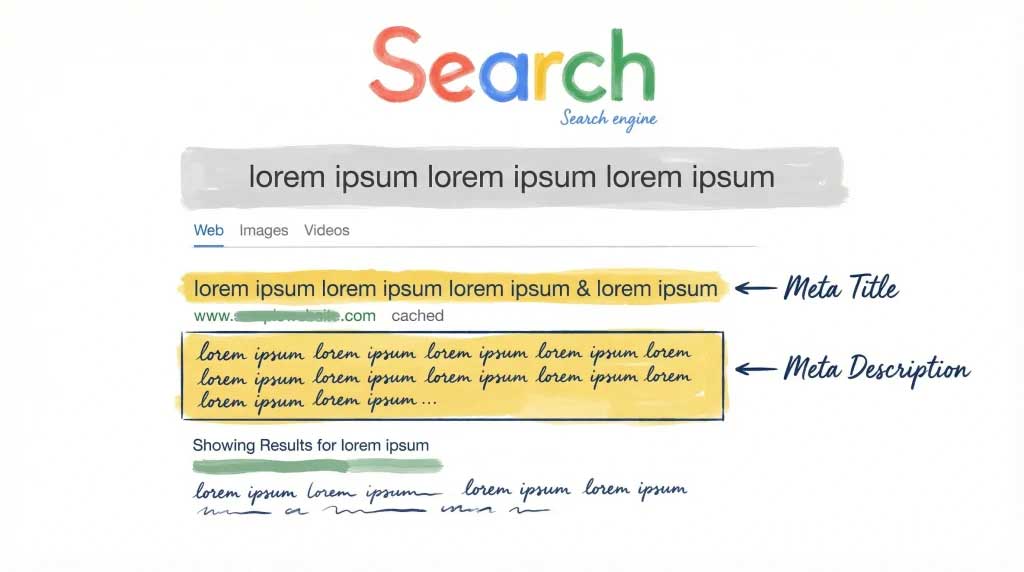
Think of meta titles and meta descriptions as good packaging for search results that helps communicate what a page is about. Optimising them provides a compelling summary in search results and encourages qualified users to click.
A good meta title should be:
- Relevant
- Concise
- Descriptive
- Naturally optimised around the primary keyword
A good meta description should:
- Summarise the page accurately
- Reflect search intent
- Include the primary topic naturally
- Avoid keyword stuffing
8. Optimise for Featured Snippets and Search Visibility

Structure parts of your content so that search engines can easily identify direct answers.
For example, you can use:
- Concise definitions
- Numbered steps
- Bullet-point lists
- Comparison tables
- Question-and-answer sections
- Clearly labeled sections
9. Don’t Forget the User Experience

A good write-up isn’t enough on its own — user experience is crucial to keep readers engaged. Readers interact with the entire page, so it’s important to pay attention to everything including:
- Mobile responsiveness
- Page speed
- Font readability
- Visual hierarchy
- Navigation
- Image optimisation
- Intrusive pop-ups
- Clear calls to action
A well-written, informative piece of content on a slow, hard-to-use website still creates a poor experience. Content, design, and technical performance must work together.
10. Keep Content Current

Writing content and publishing it isn’t the end of the SEO process. Over time, statistics become outdated, figures and recommendations change, links stop working, and search intent evolves.
Regular content audits can help you catch:
- Outdated info
- Missing subtopics
- Broken links
- Weak sections
- Old statistics
- Changes in search intent
- Opportunities for new internal links
Improving existing content is often as valuable as publishing something new.
Common SEO Content Writing Mistakes to Avoid
Keyword Stuffing
Optimising the content for search engines so heavily that it becomes stiff, unnatural and difficult to read.
Ignoring Search Intent
Failing to meet users’ expectations can lead to a poor experience, causing visitors to leave without finding the information they need.
Publishing Thin Content
Failing to cover the topic adequately offers limited value and is less likely to compete against in-depth, well-researched information.
Neglecting Updates
Publishing once and never revisiting or updating the information. Outdated content can eventually become less useful and less competitive.
Overlooking Readability
Unclear headings, large blocks of text, and complicated language discourage readers.
Forgetting Internal Links
Not connecting related pages can make it harder for visitors and search engines to discover relevant content.
SEO Content Writing Framework
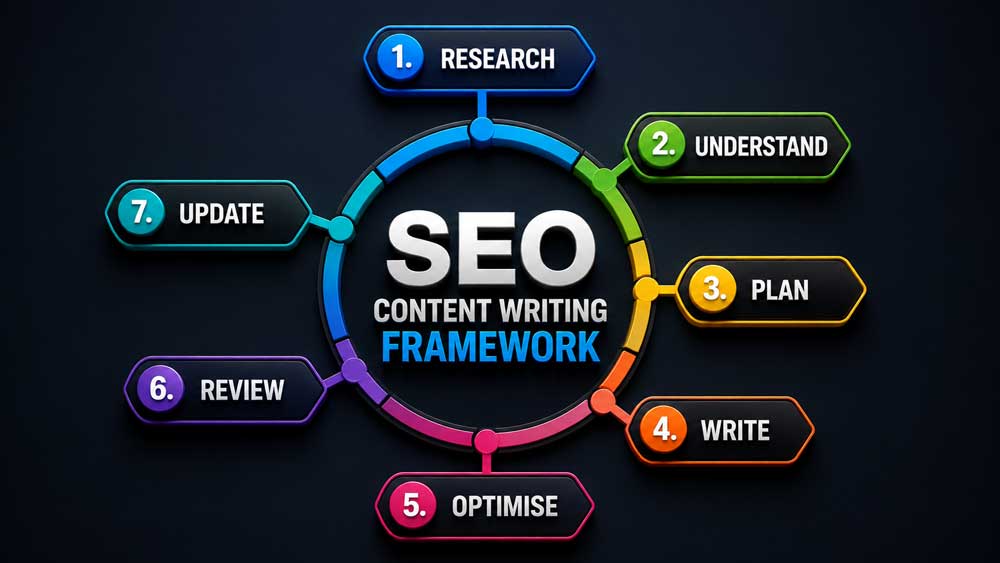
- Research — Identify keywords, competitors, questions, and reliable sources.
- Understand — Determine the search intent and audience needs.
- Plan — Build the outline, headings, internal links, and content angle.
- Write — Write clear, original, useful content for the reader.
- Optimise — Improve headings, keywords, metadata, links, images, and on-page elements.
- Review — Check accuracy, readability, grammar, intent, and SEO.
- Update — Refresh outdated information based on performance and changing search intent.
Final Thoughts
SEO content writing isn’t fundamentally different from good writing. It is not about choosing between Google and your audience either. It is good writing shaped by an understanding of how people search and how search engines evaluate relevance, quality, and trust.
Content that performs well over time combines genuine expertise with a reader-first structure, a natural voice, and the technical elements that help search engines discover, understand, and rank it.
The best practice is simple: write the piece that best answers the question a real person is asking, then structure and optimise it so search engines can understand its value.
Ready to put this into practice? Start with a content audit of your top three pages and see where search intent, structure, or E-E-A-T signals could be stronger.